In a nutshell
- 🔬 Chemistry: Acetic acid dissolves mineral “glue” (limescale) and loosens polymerised fats, while a drop of detergent lowers surface tension to lift flakes fast.
- ⏱️ Three-minute method: Warm white vinegar to a gentle shimmer, add a drop of washing-up liquid, wait a minute, then scrape—grime releases in about 3 minutes.
- 🧪 Materials: Stainless steel and enamel are fine with brief warm soaks; aluminium needs dilution and quick rinsing; cast iron loses seasoning; non-stick requires low heat and soft tools.
- 🔥 Kinetics: Heat accelerates reactions—short and hot beats long and tepid for scale-bound grime; for hard, carbonised films, switch to alkaline cleaners or gentle abrasion.
- 🛡️ Safety and practicality: Ventilate, never mix vinegar with bleach or ammonia, choose clear white vinegar (6–10% for speed), and re-oil carbon steel/cast iron after cleaning.
There’s an everyday bottle in your cupboard that behaves like a lab reagent when a pan is scarred with brown, baked-on grime. Vinegar, rich in acetic acid, doesn’t just mask stains; it attacks the chemistry that glues residues to metal. In the time it takes the kettle to boil, you can loosen a stubborn layer that seemed welded on. Yes, minutes, not hours. The secret lies in weak-acid power, heat, and a bit of surface science. Used smartly, it’s safe, cheap, and kinder to the environment than harsh oven cleaners. Here’s how and why it works so fast—and how to use it without damaging your favourite kit.
The Chemistry: How Acetic Acid Unzips Burnt-On Residues
That crust on your pan isn’t one thing. It’s a hybrid: mineral scale (calcium carbonate from hard water), polymerised oils, and browned Maillard sugars compacted by heat. Acetic acid (CH3COOH), at 5–8% in typical UK vinegar, is a weak acid with a punchy pH near 2.2 for 6% solutions. It protonates and dissolves carbonate scale—the chalky “cement” that locks burnt food to metal—releasing CO2 and freeing edges. It also chelates some metal ions at the surface, disrupting microscopic bonds where residues anchor. Once the cement is gone, the crust loses its grip.
Heat speeds everything. Warm acetic acid diffuses faster and reacts more readily, softening polymer networks at their polar sites so they swell and lift. Add one drop of washing-up liquid and you lower surface tension, letting the liquid creep beneath flakes like capillary crowbars. That’s why a seemingly impossible patch yields in about three minutes. Not magic. Just elegant chemistry: acid for minerals, mild surfactancy for lift, and thermal energy to accelerate the lot.
Three-Minute Method: A Quick, Safe Routine for Most Pans
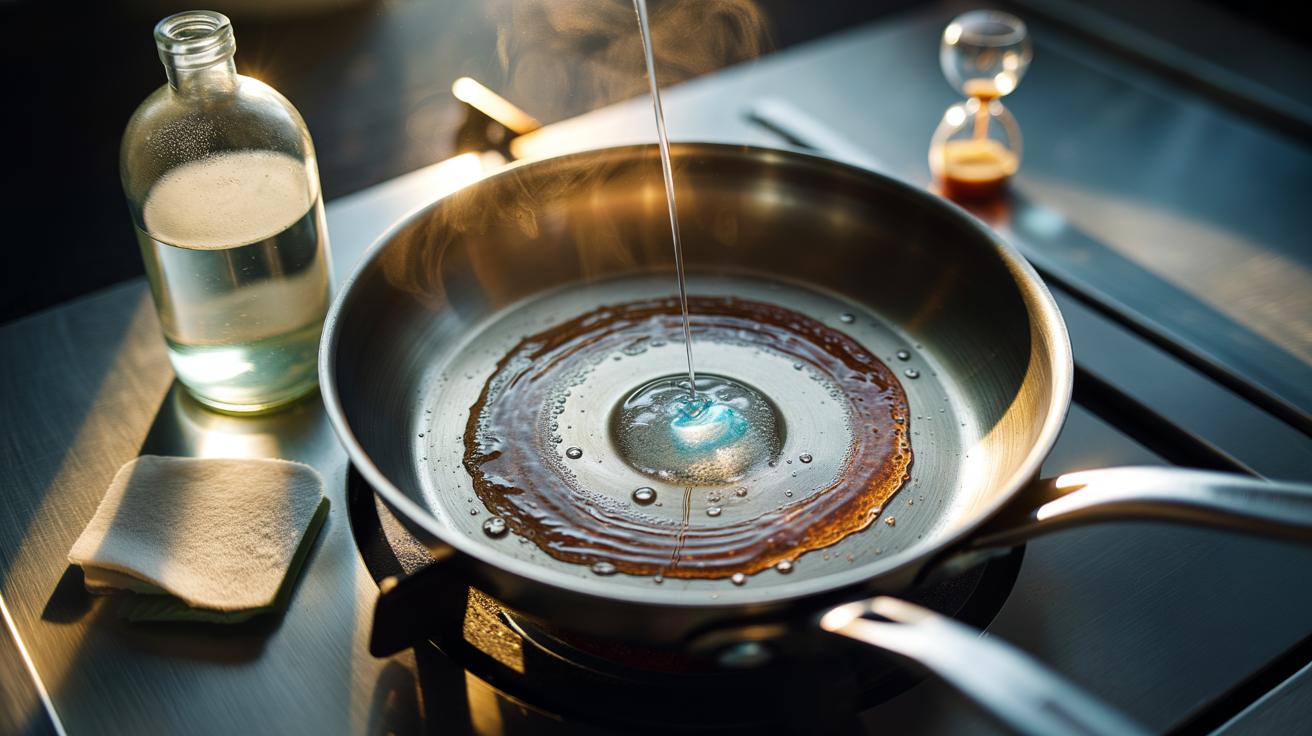
1) Knock off loose debris with a spatula. 2) Pour in enough white distilled vinegar to just cover the grime—about 100–150 ml for a medium pan. For sensitive metals, cut 1:1 with water. 3) Set on the hob and warm to a lively shimmer, not a rolling boil, for 60–90 seconds. Gentle heat is the rate multiplier. 4) Add a single drop of washing-up liquid; swirl to wet every corner. 5) Kill the heat and wait another minute as chemistry and capillarity do the lifting. 6) Nudge the loosened film with a wooden or silicone scraper; it should slide away in sheets.
If a few spots cling, sprinkle a teaspoon of bicarbonate of soda after draining the vinegar. The fizzing CO2 provides mechanical lift, while the mild abrasiveness helps, though note you’re neutralising the acid at this stage. Rinse well, then dry. For carbon steel or cast iron you’ve intentionally used vinegar on, re-oil and heat to rebuild protection. Ventilate the kitchen, avoid mixing vinegar with bleach or ammonia, and keep the simmer short. For stained enamel, use only warm (not hot) vinegar to prevent thermal shock.
Material Matters: What Vinegar Loves—and What It Loathes
Vinegar is broadly compatible, but pan materials respond differently. Stainless steel laughs off short acidic baths and often emerges mirror-bright because acetic acid removes limescale haze. Enamel and glass tolerate brief warm soaks; avoid sudden temperature swings. Aluminium can pit with prolonged acid contact, so dilute and keep exposure short, then rinse thoroughly. Copper quickly sheds tarnish, though uniform patina lovers may prefer gentler polishes. Cast iron and carbon steel will lose seasoning—the thin polymer layer you work so hard to build—so only use vinegar deliberately when you’re prepared to reseason. Non-stick coatings (PTFE or ceramic) dislike overheating; a short, warm vinegar sit is fine, but skip boiling and abrasive tools.
| Material | Vinegar Use? | Tips | Typical Time |
|---|---|---|---|
| Stainless steel | Yes | Heat gently; add a drop of detergent | 2–4 minutes |
| Aluminium | Yes, with care | Dilute 1:1; short contact; rinse fast | 1–3 minutes |
| Enamel/Glass | Yes | No thermal shock; warm, not boiling | 3–5 minutes |
| Copper | Yes | Test small patch; protect finish | 1–2 minutes |
| Cast iron/Carbon steel | Only if reseasoning | Expect stripped seasoning; re-oil and bake | 1–2 minutes |
| Non-stick | Yes, gently | No boil; soft sponge only | 2–3 minutes |
Why Heat and Time Matter: Kinetics in Your Kitchen
Cleaning isn’t only chemistry; it’s kinetics. Raise temperature, and reaction rates leap as molecules collide more often. A 20°C bump can double the speed at which acetic acid dissolves carbonate “glue,” explaining why a quick simmer outperforms a cold soak. Contact time is the other lever. Short and hot beats long and tepid for mineral-laden grime. For purely carbonised polymer—black, glassy films from extreme heat—acid underwhelms; you’ll need an alkaline degreaser, an overnight washing-soda soak, or careful mechanical abrasion.
Strength matters too. UK “cleaning vinegar” at 6–10% works faster than 4–5% table vinegar. If you only have malt vinegar, it will still cut scale, but choose clear white vinegar to avoid tinting pale enamel. Agitation magnifies results: a swirl here, a scrape there, and fresh acid reaches newly exposed interfaces. The three-minute win is realistic when the residue contains mineral scale and partially oxidised fats. When it doesn’t, don’t force it—switch tactics, protect the surface, and let science, not elbow grease, set the pace.
In the end, the brilliance of vinegar is its mix of speed, safety, and simplicity. It loosens the mineral glue that locks grime to metal, then heat and a whisper of surfactant flick the debris free. Small bottle, big leverage. Keep one by the hob for the nights when dinner gets away from you and the pan pays the price. Used with a cool head and a warm hob, it’s an affordable ally that spares both wrists and wallets. Which pan will you try it on first—and what result would convince you to make vinegar your go-to rescue for kitchen disasters?
Did you like it?4.6/5 (26)