In a nutshell
- 💡 Perceived luxury is driven by attention bias: salient contrast, symmetry, and status cues guide quick judgments, and first impressions dominate the narrative.
- 🕯️ Elevate sensory cues with layered lighting, tactile textures, calm acoustics, and a consistent scent; embrace negative space and ruthless editing to reduce visual noise.
- 🎯 Use design tactics that redirect the gaze: a clear focal point, controlled sightlines, muted palettes with confident accents, and upgraded high-touch details (handles, switches, taps).
- 🛎️ Borrow from hospitality psychology: apply anchoring and the placebo effect, and build a coherent script of consistent cues across light, sound, scent, and order.
- 🧭 Actionable playbook: curate the first five seconds, invest in one or two high-signal details, and keep function seamless so aesthetics read as quietly premium.
Luxury isn’t always a price point; it’s a pattern of attention. When we walk into a room, our brains seize on a few potent cues, then weave a story about quality, status, and care. The trick is that these cues can be designed, not just bought. In small flats, tired offices, or rentals with tight rules, the same principle applies: guide the gaze, delight the senses, and edit the noise. Think theatre, not budget. With a handful of deliberate choices — from light and texture to sound and scent — you can transform the everyday into something that feels effortlessly premium.
The Psychology of Attention: Why Your Eye Chooses Luxury
Look around a room and you won’t measure value; you’ll feel it. That feeling often begins with attention bias, the brain’s habit of favouring salient information and downplaying everything else. In design, salience is created through contrast, novel textures, symmetry, and confident focal points. When a space offers a few striking signals, we infer broader quality. Your eye takes a shortcut; your mind writes the story. That’s why a single sculptural lamp can lift an entire lounge, while a sea of middling choices disappears into cognitive fog.
Luxury is also performative. We read spaces as social scripts — how they’re meant to be used and who belongs there. The human brain loves status cues: weighty hardware, quiet doors, generous negative space. These aren’t trivial details; they are behavioural nudges that communicate care and permanence. In cognitive terms, quick, intuitive processing (often called System 1 thinking) does most of the heavy lifting. It rewards clarity, simplicity, and sensory coherence, punishing clutter and mixed messages.
Crucially, first impressions dominate. The entry experience sets expectations that colour everything that follows. Curate the first five seconds — the sightline, the temperature, a subtle fragrance — and you can tilt perception before scrutiny kicks in. Get those first beats right and the ordinary feels elevated, even when the budget is sensible.
Sensory Cues That Fake Opulence in Ordinary Rooms
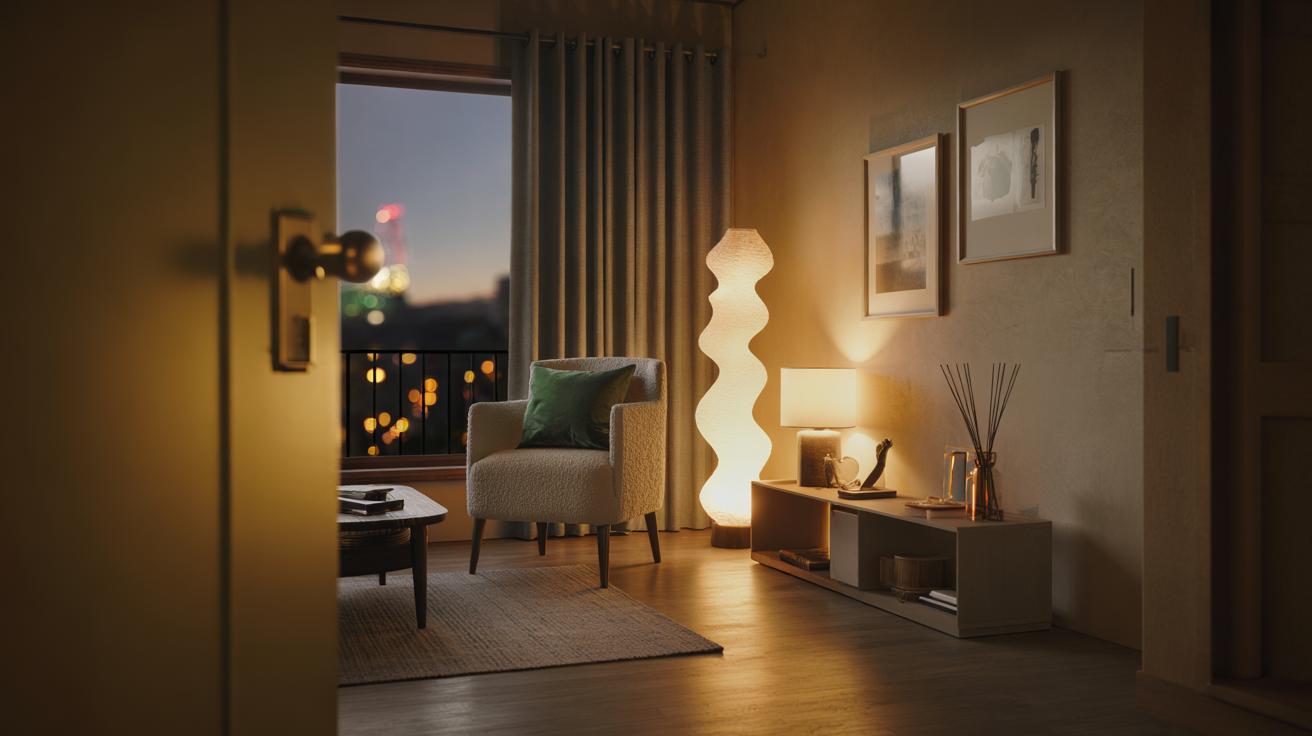
Begin with light. A space reads expensive when it’s layered: warm, dimmable ambient light to flatter surfaces, task light where you need clarity, and a final wash of accent light to stage vignettes. Then texture. Pair one deliberately tactile surface — bouclé, brushed metal, honed stone — with smoother companions so the hand and eye register contrast. Luxury lives in the junctions: the line where a wall meets a skirting, a handle’s touchpoint, a seam that sits perfectly straight. Sound matters too. Soft furnishings that absorb echo create instant calm, while a door that closes with a soft thud suggests engineering and care.
Scent and temperature finish the illusion. A restrained, consistent fragrance profile feels curated; a stable, cosy temperature reduces cognitive friction. Cleanliness and order are non-negotiable. Edit surfaces, leave generous negative space, and align objects with intent. Your brain rewards legibility. The result is a room that whispers rather than shouts, yet reads as “more” with less. Use the table below as a quick cue-to-fix guide.
| Cue | Attention Mechanism | Quick Fix | Approx. Cost |
|---|---|---|---|
| Lighting | Salience, contrast | Dimmable bulbs, one statement lamp | Low–Medium |
| Texture | Tactile novelty | Single premium throw or rug | Low–Medium |
| Scent | Memory priming | One subtle diffuser, consistent profile | Low |
| Sound | Acoustic calm | Curtains, felt pads, soft door bumpers | Low |
Design Tactics: Redirecting Attention to High-Value Moments
Decide what the room is “about” and stage that moment. Create a focal point — a piece of art, a mantel vignette, a striking headboard — and make everything else supportive. Then choreograph a path: the first sightline from the door should land on that star. If the eye knows where to rest, the brain calls the scene composed. Colour can shepherd attention too. Use a muted palette overall, then a confident accent in one or two places. This amplifies perceived richness without multiplying spend.
Edit aggressively. Hide utilities in handsome baskets, use uniform containers inside open shelving, and cap the number of visible objects. Swap plastic for glass or metal on daily touchpoints: handles, switches, taps. Upgrade trims — a taller skirting or a slim picture rail — to signal architectural intent. In small spaces, floating shelves and leggy furniture reveal more floor, creating the illusion of generosity. Finally, layer textiles at “pause points”: a velvet cushion on a reading chair, linen on a bedside, wool underfoot. These micro-luxuries cluster sensation where it’s most felt and remembered.
Data, Placebo, and the Luxury Script in Retail and Hospitality
Shops and hotels have long exploited anchoring — placing an expensive decoy to make the rest look sensible — and the design world mirrors that psychology at home. One premium object reframes surrounding items. The placebo effect also applies: when signage, staff attire, and lighting signal quality, customers rate the same product as better. Translate that domestically with consistent typography on labels, a cohesive palette, and a few tactile surprises at key touchpoints like the entry console or dining table edge.
Acoustics carry disproportionate weight in hospitality and should in homes too. A balanced soundscape — soft background noise, muffled footsteps, discreet door closes — reduces stress and stretches time, which people interpret as luxury. Scent zoning works: citrus at arrival for freshness, resinous notes in living areas for depth. In restaurants, the table feels premium when it’s lit from the side, not above; apply that trick to desks and bedside tables. Quality is a story told by consistent cues, not a list of expensive brands. When the script is coherent — light, touch, sound, and order in concert — the audience applauds with their attention.
Luxury is attention, edited and directed. If you curate the first glance and the last touch, the middle will feel elevated by association. Start with light, remove noise, then invest in one or two high-signal details that people will notice and remember. Let function be flawless and aesthetics quietly confident. The cost can be modest; the effect, profound. What single cue will you elevate this week — light, texture, scent, or sound — and how will you design your space to make that cue impossible to ignore?
Did you like it?4.5/5 (22)