In a nutshell
- ⚡ Anti-static chemistry does the heavy lifting: cationic surfactants form a lubricating film that neutralises charge hot-spots, reduces adhesion, and lowers surface tension so water penetrates burnt-on residue.
- 🧽 The dryer sheet acts as a targeted delivery system: persistent contact concentrates actives at the interface, its matrix traps loosened crumbs, and low-friction glide makes wiping feel effortless—delivering faster cleaning than soak-and-scrub.
- 🧪 Versus common fixes, it excels on mixed, carbonised messes: better than a simple hot water soak for speed, gentler than abrasive bicarbonate pastes, and more effective on polymerised fats than standard washing-up liquid.
- 🔒 Smart use and safety: soak 10–20 minutes, wipe with the sheet, then thoroughly rinse and rewash; avoid damaging cast iron seasoning, go gentle on bare aluminium and copper, and consider gloves for sensitive skin.
- 🍳 Practical takeaway: reserve this trick as an emergency rescue for scorched pans—especially stainless steel and enamel—where charge control, surfactancy, and soft mechanical action combine to lift stubborn grime quickly.
It sounds like a hack from a late-night telly advert, yet the claim stands: a humble dryer sheet can help scour scorched pans in seconds flat. The secret isn’t magic. It’s chemistry designed for the laundry that moonlights at the sink. When that wafer-thin sheet gets wet, it releases anti-static agents and softeners that undermine the stubborn bonds between pan and burnt residue. What follows is less elbow grease and more glide. This is a story about charge, surface tension, and clever molecular shape. It’s also about the fabric sheet itself, a gentle abrasive that doesn’t bite. Here’s why those anti-static agents loosen tough crumbs effortlessly.
How Anti-Static Chemistry Dislodges Burnt-On Bits
Dryer sheets carry cationic surfactants—often quaternary ammonium compounds—built like molecular tadpoles: a positively charged head and a greasy tail. The head loves surfaces. The tail loves oils. Scorched residues are complex: dehydrated sugars, denatured proteins, polymerised fats. They cling to microscopically rough metal via electrostatic attraction and hydrophobic interactions. When the sheet soaks, those cationic molecules migrate, adsorbing to the residue and to the pan’s oxide layer. The result is a thin, lubricating film that neutralises charge hot-spots and reduces adhesion, nudging water into crevices the way a pry bar finds a seam.
Surfactants also lower surface tension. Water spreads instead of beading, penetrating the baked crust. At the same time, the sheet leaches softeners—fatty compounds that act like release agents on a baking tin. That dual action weakens cohesive bonds within the residue and adhesive bonds to the metal. Picture a brittle toffee softening at the edges until it lifts cleanly. The non-woven sheet adds a third nudge: gentle mechanical drag. It’s not sandpaper. It’s closer to a squeegee, smearing and lifting loosened fragments without gouging stainless steel.
One more quiet helper: time. Give the chemistry minutes, not seconds, and diffusion does the heavy lifting. The sheet sits like a poultice, holding a reservoir of active molecules against the worst spots. Because the actives are substantive to surfaces, they don’t just float away—they linger where they’re needed most. When you finally wipe, the residue has already given up much of its grip. That’s why the first pass can feel suspiciously easy.
Why Fabric Sheets Work Faster Than Soak-and-Scrub
Plain soaking asks hot water to do what it does best: swell, cool, and soften. It works, but slowly. A dryer sheet upgrades the bath into a targeted delivery system. Surfactants reduce the energy barrier for detachment, while the sheet’s matrix traps loosened particles rather than letting them re-adhere. Speed comes from three synergies: persistent contact, concentrated actives at the interface, and low-friction wiping. It’s the difference between splashing detergent near a stain and pressing a treated pad directly on it. The physics favours the latter.
Compared with common kitchen fixes, the sheet is oddly elegant. Bicarbonate pastes abrade well but can haze soft aluminium. Acid-vinegar fizz is dramatic yet often neutralises itself, leaving salt water that does little for polymerised grease. Washing-up liquid excels at emulsifying fresh fats but struggles to infiltrate carbonised layers. The dryer sheet’s cationic charge flips the script: it bonds where anionic soaps sometimes don’t, especially on negatively charged metal oxides. And because the sheet glides, effort plummets while control rises. That means fewer frantic scours, fewer scratches, fewer muttered regrets.
| Method | Mechanism | Typical Time | Best For |
|---|---|---|---|
| Hot water soak | Hydration, thermal softening | 30–60 min | Light browning |
| Washing-up liquid | Anionic surfactants emulsify fats | 15–45 min | Grease films |
| Bicarbonate paste | Mild abrasion, alkalinity | 20–40 min | Sticky sugars |
| Dryer sheet soak | Cationic surfactants, lubricants, wiping matrix | 10–20 min | Burnt-on mixed residue |
Smart, Safe Use in a Real Kitchen
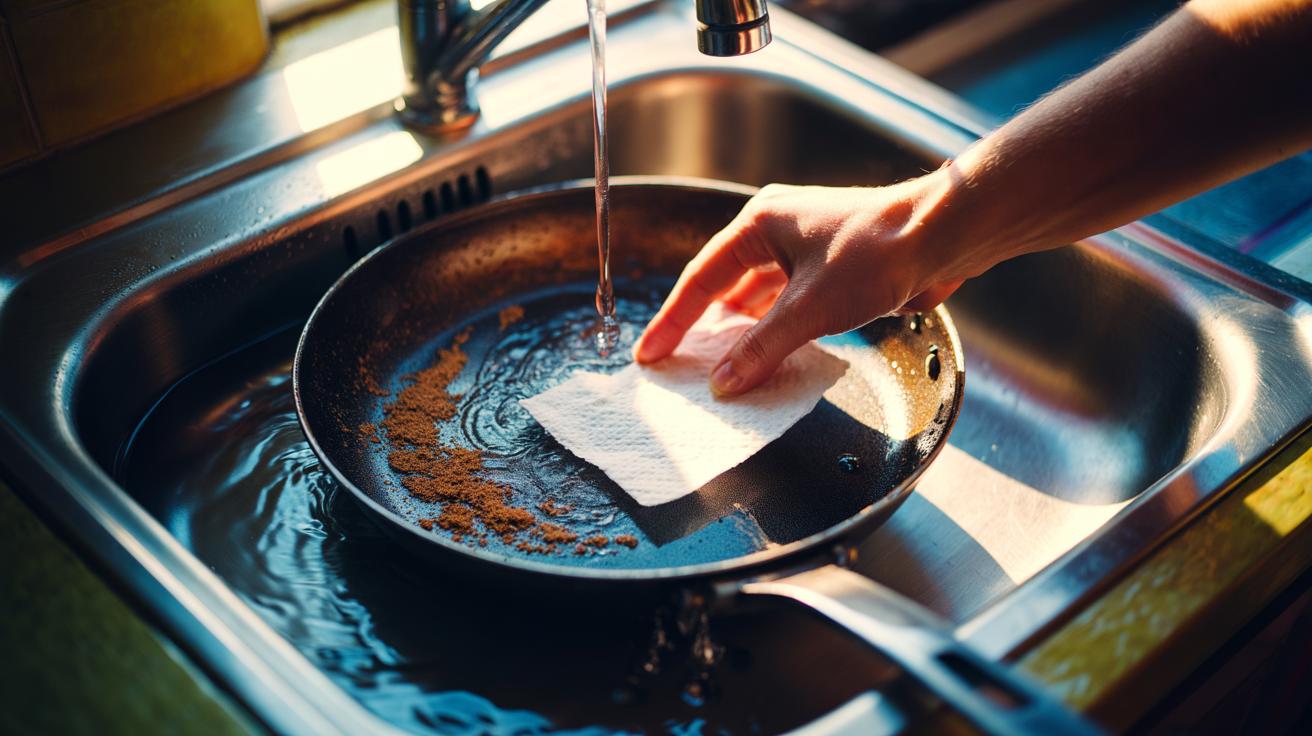
Practicalities matter. Pop the pan on the counter, add hot water, and submerge a single sheet. Wait long enough for diffusion—ten minutes usually, twenty for a Friday-night disaster. Then wipe with the sheet itself. The glide tells you it’s working. Rinse thoroughly to remove fragrance oils and quats; they’re not for eating. Always wash again with standard detergent before the pan returns to service. Stainless steel and enamelled iron play nicely. Bare aluminium and copper? Gentle pressure only, and check for lacquered exteriors.
Cast iron is the exception. The seasoning is a delicate polymer layer you’ve spent months building. Don’t risk it. For cast iron, stick to hot water, a chainmail scrubber, and oil reconditioning. Non-stick coatings are generally safe with light wiping, but avoid soaking so long that edges lift; inspect before use. If skin is sensitive, gloves help, as cationic surfactants can irritate. And mind the environmental ledger: single-use sheets aren’t saints. Use one sparingly, then switch back to classic methods for everyday tidying. The trick’s value lies in triage—fast rescue when dinner bites back, not routine maintenance.
For the curious, yes, the chemistry scales. The same class of anti-static agents softens textiles by taming friction and static cling; in a pan, they tame residue instead. That doesn’t make dryer sheets food-safe additives. It makes them effective pre-cleaners provided you rinse to neutrality. If you want a minimalist cupboard, washing-up liquid plus time still solves 80% of messes. Keep the sheet method for the other 20%—the scorch rings, the caramelised sugar, the forgotten rice. When the smell of toast-that-wasn’t lingers, reach for the sheet.
In the end, a dryer sheet succeeds because it combines chemistry with form: charge control to unstick, surfactancy to wet, and a soft pad to lift. It’s quick, it’s oddly satisfying, and—used wisely—it’s kind to your cookware. Consider it the emergency service of dirty pans rather than an everyday responder. You’ll save time, spare your wrists, and keep that stainless steel shining. The next time dinner goes from golden to blackened, will you rely on soak-and-hope, or will you test the charge-flipping science hiding in your laundry cupboard?
Did you like it?4.6/5 (24)